GOTS Certified Organic Hoodies are more than soft sweatshirts made from “natural” fibers. They represent a controlled textile chain, from certified organic cotton fields to spinning, dyeing, sewing, and labeling. The Global Organic Textile Standard requires at least 95% certified organic fibers for its “organic” grade. Its “made with organic” grade requires at least 70%. Approved chemical inputs, wastewater treatment, and social criteria also matter.
The scale remains significant, yet limited. Textile Exchange’s Organic Cotton Market Report 2023 reported about 342,265 metric tonnes of organic cotton fiber production in 2021/22. That volume represented roughly 1.4% of global cotton production. The figure shows progress, but it also exposes a weakness. Organic cotton is not yet the industry default. Demand can grow faster than verified supply.
Claudia Bross, a GOTS Director, describes the standard as “a holistic approach to sustainability.” Her statement reflects the certification’s wider purpose. A credible hoodie should include traceable fabric, certified processing facilities, and supporting transaction records. Details matter. Check the neck label, drawcords, ribbed cuffs, fleece backing, and printed graphics. Not every trim automatically shares the same certification status.
The label is not magic. It does not prove perfect environmental performance or guarantee universal ethical behavior. Buyers should still examine supplier documents, product composition, and certification scope. This guide explains how GOTS Certified Organic Hoodies are assessed, what the label really confirms, and where careful judgment remains necessary.
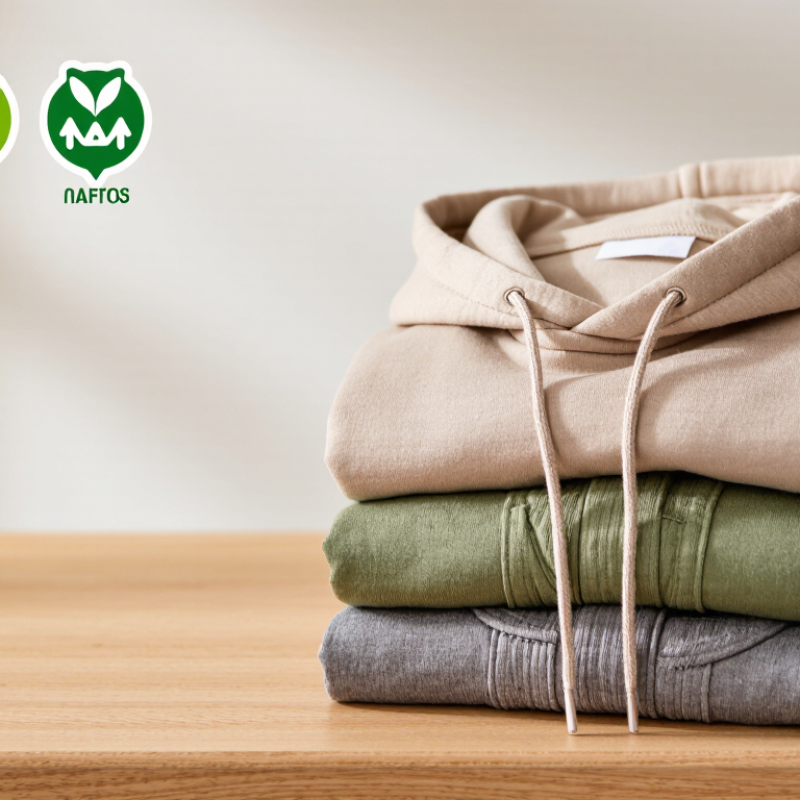
What Are GOTS Certified Organic Hoodies?
A GOTS-certified organic hoodie must meet a clear fibre threshold. The “organic” grade requires at least 95% certified organic fibres. The “made with organic” grade requires at least 70%. The remaining fibres may be approved recycled or conventional materials, depending on the product’s certification details. This difference matters. A hoodie containing 70% organic cotton is not equivalent to one containing 95%.
The Global Organic Textile Standard also evaluates processing, dyes, wastewater, and social criteria. A cotton hoodie cannot earn certification through fibre content alone. Buyers should check the supplier’s valid scope certificate and product transaction records. Small details matter, including the fibre percentage and certified facility name. According to Textile Exchange’s Organic Cotton Market Report 2024, organic cotton production reached about 222,134 metric tonnes in the 2022/23 season. It represented only around 0.33% of global cotton production. That figure shows why certification and traceability remain important. Still, a certificate does not prove that every sustainability claim is perfect. I would question vague wording. “Organic” can describe the fibre, while the finished hoodie depends on the entire approved supply chain. The label helps, but careful reading remains necessary.
| Dimension | GOTS-Certified Organic Hoodie Information | Why It Matters |
|---|---|---|
| Certification meaning | The Global Organic Textile Standard (GOTS) covers certified organic fibres and environmental and social criteria throughout defined textile-processing stages. | It evaluates more than the fibre source alone. |
| “Organic” label grade | At least 95% of the product’s textile fibres must be certified organic fibres. The remaining fibre content must meet the standard’s permitted-material requirements. | This is the higher organic-fibre threshold used for an “organic” GOTS label grade. |
| “Made with organic” label grade | At least 70% of the product’s textile fibres must be certified organic fibres. The remaining fibres must comply with the standard’s applicable requirements. | A hoodie can contain a blend and still qualify for the lower GOTS label grade when all other criteria are satisfied. |
| Fibre calculation | The 70% or 95% threshold applies to the relevant textile fibre content, not automatically to every component by total product weight. | Zippers, buttons, labels, sewing thread, prints, and other accessories are assessed under separate requirements. |
| Typical hoodie body | A hoodie may use certified organic cotton, certified organic wool, or another permitted certified organic fibre, alone or in a compliant blend. | The fibre composition should be checked against the product’s certification documentation. |
| Blended construction | A 70% organic-fibre hoodie could contain up to approximately 30% other permitted fibres, subject to GOTS material and product rules. A 95% organic-fibre hoodie has a much smaller allowance for non-organic fibre content. | The word “organic” does not necessarily mean that every fibre in the garment is organic. |
| Organic-fibre sourcing | Organic fibres must be certified according to an approved organic-farming standard and must be supported by transaction and supply-chain documentation. | Certification helps verify the claimed organic status rather than relying only on marketing language. |
| Chemical management | GOTS restricts hazardous substances and requires approved chemical inputs and controlled processing methods. | Dyes, finishes, detergents, and printing chemicals are subject to environmental and human-health requirements. |
| Wastewater and processing | Wet-processing facilities must meet wastewater-treatment and environmental-management requirements applicable to their operations. | The standard addresses impacts created during dyeing, washing, printing, and finishing. |
| Social criteria | Certified entities must follow social criteria based on International Labour Organization principles, including requirements concerning forced labour, child labour, discrimination, health, and safety. | The certification includes workplace conditions in the covered supply chain. |
| Traceability | Certified materials and products must be identified, separated where required, and documented through the certified supply chain. | Traceability connects the finished hoodie to certified inputs and processing sites. |
| Certification scope | GOTS certification applies to certified operators, facilities, products, and supply-chain activities within the certificate’s stated scope. | A single certified facility does not automatically certify every stage or every product connected with it. |
| How to verify a claim | Look for the GOTS label grade, certification reference, certified-entity information, fibre composition, and the approved certifier’s documentation where available. | A generic “organic” claim alone does not confirm that the hoodie meets GOTS requirements. |
Key takeaway: A GOTS label grade of “organic” requires at least 95% certified organic textile fibres, while “made with organic” requires at least 70%. Both grades also depend on applicable environmental, chemical, social, traceability, and certification requirements.
It means the hoodie contains certified organic fibres within a defined percentage. The label alone does not guarantee perfect sustainability.
The 95% grade contains at least 95% certified organic fibres. The 70% grade contains at least 70%.A hoodie with 70% organic cotton is not equivalent to one with 95%.
The remaining fibres may include approved recycled or conventional materials. The exact blend should appear in the certification details.
No. Certification also reviews processing, dyes, wastewater controls, and social conditions.The whole chain matters.
Ask for a valid scope certificate and product transaction records. Check the fibre percentage and certified facility name.Small details matter.
The chain can include farming, ginning, spinning, knitting, dyeing, cutting, and sewing. Approved facilities and documented controls should cover these stages.
No. Dyeing still uses water, energy, and chemical inputs. Transport, washing, drying, and disposal also create impacts.It is not impact-free.
Organic cotton represents a small share of global cotton production. Traceability connects the fibre to farms, facilities, and shipments.Small share, large responsibility.
Be cautious with vague words such as “organic” without percentages or records. A certificate proves defined requirements, not every environmental claim.I would still ask about durability and farm-level water use.
GOTS Certified Organic Hoodies are made with organically produced fibres and assessed across the textile supply chain, from fibre handling to final manufacturing. Under GOTS rules, products must contain at least 70% certified organic fibres to qualify for an organic-fibre claim, while the highest “organic” designation generally requires 95% or more. The remaining fibres, when permitted, must meet strict sourcing requirements.
Certification also covers how a hoodie is processed. Approved chemicals, responsible dyeing, and limits on harmful substances help protect workers, consumers, and the environment. Certified facilities must maintain records that allow materials to be traced through spinning, knitting, sewing, dyeing, and finishing. GOTS further addresses wastewater treatment, waste management, workplace safety, fair labour practices, and social compliance. Although organic cotton represents only about 1.4% of global fibre production, GOTS plays an important role by creating a recognizable standard for verifying organic content and more responsible textile manufacturing.